Technical E-commerce 2026: Payments, Platforms, and ERP for Baltic & EU Markets
What happens after the ‘Pay’ button
An online shop’s profit depends on more than prices and advertising. What happens after the ‘Pay’ button matters just as much. What does each payment cost? How many payments does the bank decline? How many hours does your accountant spend checking that the bank statement matches your orders?
This guide is for a growing online shop that sells across the Baltics and the EU. We compare the payment providers that Baltic shops use most and show how to work out what payments really cost. We also explain how to choose an e-commerce platform and how to connect it to your accounting or ERP system. The ‘From a CFO’s perspective’ sections are for readers who want more depth.
The example is fictional. It shows how the rules work in practice.
Northern Bean is a small coffee roastery in Riga. It sells freshly roasted beans and brewing gear through its own online shop. The average order is €40 — two or three bags of coffee and some filters. In its first year the shop receives around 30 orders a month. Six in ten buyers pay through online banking; four pay by card, Apple Pay or Google Pay. Parcels go to parcel lockers.
Through this guide you will see how the company’s technical decisions change as orders grow to 800 and later to 5,000 a month.
Key takeaways
- The true cost of payments goes beyond the percentage. For smaller average order values, fixed per-transaction fees dominate the cost structure. A provider with a slightly higher fee but a better acceptance rate for local methods — Baltic bank links, iDEAL or BLIK — often yields a higher net profit than the ‘cheapest’ global option.
- Watch out for hidden third-party fees. Shopify is excellent for scaling, but Shopify Payments does not support Baltic bank links. If you add a local gateway such as Montonio or MakeCommerce to capture those regional sales, Shopify applies a third-party transaction fee of up to 2%. That changes your calculations completely.
- Automate reconciliation with clearing accounts. To scale without drowning your accounting team in manual data entry, your ERP — Odoo or Microsoft Dynamics 365, for example — needs a dedicated clearing account for each payment provider. It reconciles the gross order value, the deducted commissions and the net payout that reaches your bank.
- Prepare for e-invoicing and customs shifts. The EU’s VAT in the Digital Age (ViDA) package lets member states mandate domestic B2B e-invoicing now, and brings digital reporting for cross-border B2B transactions from 1 July 2030. Latvia moves earlier: structured e-invoices between local companies become mandatory on 1 January 2028. Your systems also have to handle OSS reporting and the end of de minimis customs relief.
How money gets from the buyer to your account
For the buyer, paying is a single click. Behind it several parties are at work. Each of them affects three things: what you pay per payment, how many payments are declined and how much work your bookkeeping takes.
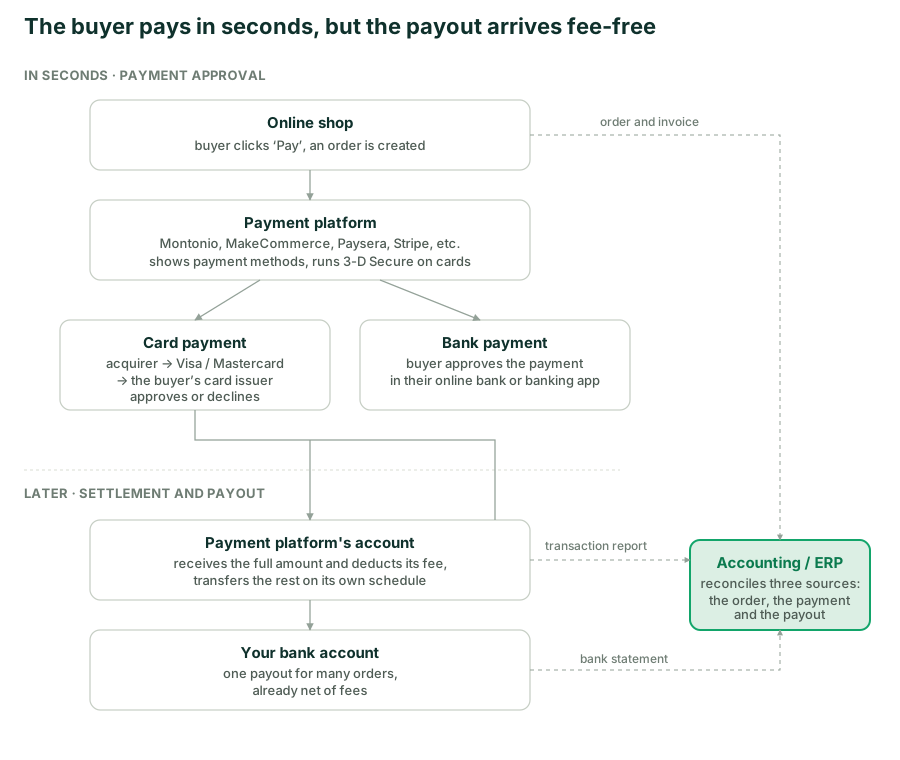
Authorisation takes seconds. The money reaches your account later — as one payout for many orders, with the fees already deducted.
- The payment provider (payment service provider, PSP) shows the buyer the payment methods and passes the payment on. Popular providers in the Baltics include Montonio, MakeCommerce, Paysera and Stripe.
- A card payment is processed by the acquirer. Through the Visa or Mastercard network it asks the buyer’s card issuer whether to approve the payment. Every link in this chain has its own fee.
- In a bank payment the buyer approves the transfer in online banking or the bank’s app. No card network is involved. That is why some providers charge less for bank payments than for cards.
- The payout: the provider collects the money, deducts its fees and transfers the balance to your bank account on the schedule set in your contract.
The last step creates the most work. The bank statement shows a single amount. Behind it there may be dozens of orders, a few refunds and the fees. So three sources have to be reconciled: the order in the shop, the transaction in the provider’s report and the payout on the bank statement. We explain how to automate this in the section on connecting to your ERP.
Payment providers in the Baltics: what they offer and what they cost
We compare four providers. Baltic online shops use them often, and all four publish their prices. They differ not only in price but also in the payment methods they offer.
- Montonio — built in the Baltics. One contract covers bank payments, cards, Apple Pay, Google Pay, pay later and shipping. There is a monthly fee, but bank payments are cheap.
- MakeCommerce — a brand of the Estonian company Maksekeskus AS, with a branch in Latvia. There is no monthly fee. A bank payment costs the same as a card payment.
- Paysera — a Lithuanian electronic money institution. Prices are low while volumes are small. For card payments, Paysera holds back part of the money as a reserve.
- Stripe — a global platform. Its strengths are cards, subscriptions and many currencies. It serves European customers from Ireland. Baltic bank payments are not in its standard price list.
Larger merchants have other options. Klix by Citadele is a bank-run solution, and Adyen is an international platform that uses the Interchange++ model. We cover that in the next section. Prices for these are usually set individually.
| Montonio Starter | Montonio Core | MakeCommerce | Paysera | Stripe | |
|---|---|---|---|---|---|
| Monthly fee | €11.99 | €14.99 | none | none | none |
| Bank payment | €0.20 | €0.05 | 1.5% + €0.15 | 0.90% (min €0.10, max €0.40) | — |
| EU consumer cards, Apple Pay, Google Pay | 1.49% + €0.25 | 1.29% + €0.20 | 1.5% + €0.15 | 1.45% (min €0.15) | 1.5% + €0.25 |
| EU commercial cards | 2.39% + €0.20 | 2.39% + €0.20 | 1.5% + €0.15 | 1.45% (min €0.15) | 2.8% + €0.25 (premium cards) |
| UK cards | 2.50% + €0.20 | 2.50% + €0.20 | 1.5% + €0.15 | 2.90% (min €0.15) | 2.5% + €0.25 |
| Other non-EU cards | 2.99% + €0.20 | 2.99% + €0.20 | 1.5% + €0.15 | 2.90% (min €0.15) | 3.15% + €0.25 |
| Buy now, pay later | 2.90% | 2.49% | 3.5% | — | separate price list |
| Dispute (chargeback) | €20 | €20 | €20 | €30 | €20 |
Prices exclude VAT. We took them from the providers’ public price lists and checked them on 27 September 2026. “—” means the public price list shows no such price.
- A Montonio Core bank payment costs €0.15 if you enable refunds for bank payments. For commercial cards issued outside the EU, Montonio charges 3.60% + €0.20.
- The MakeCommerce price list applies to customers who joined after 1 June 2025.
- The Paysera prices in the table are the entry-level tier. They fall as the number of transactions in the last 30 days grows. Above 750 transactions, prices are set individually. For card payments, Paysera holds back 100% of the amount for three days and 5% for three months.
- For non-EU cards, Stripe adds a further 2% if currency conversion is needed. If you contest a dispute, Stripe charges another €20. You get it back if you win.
There is no single cheapest provider. Montonio Core pays off when most buyers use online banking, although at low volumes the monthly fee is noticeable. MakeCommerce has no monthly fee, but a bank payment costs as much as a card payment. Paysera is cheap for small volumes but holds money back. Stripe is strong for cards and foreign buyers, but it has no Baltic bank payments.
Which provider is cheapest for you? It depends on your number of orders, your average order value and your mix of payment methods. We show how to work it out in the next sections.
How to evaluate a payment provider
Price is only one criterion. Check seven things before you sign a contract.
- Pricing model. Do you pay one rate for any card (blended) or the interchange fee plus a mark-up (Interchange++)?
- Fixed fee per transaction. For small orders it makes up most of the cost.
- Payment methods. Does the provider offer Baltic bank payments? Does it offer the methods that are popular in your export markets?
- Acceptance rate. Every declined payment is a lost sale. More on this later in the guide.
- Payouts and reserves. How often does money reach your account? Does the provider hold part of it back as a reserve?
- Disputes, refunds and the contract. What do a dispute, a refund and currency conversion cost? How can the contract be ended?
- Reports and integration. Does the report show the fee and payout number for each transaction? Can the data be loaded into your accounting system automatically?
The fixed fee: why a small order costs more
A fee of 1.5% + €0.25 looks like 1.5%. The effective rate, however, depends on the order value.
| Order value | Fee (1.5% + €0.25) | Effective rate |
|---|---|---|
| €10 | €0.40 | 4.0% |
| €40 | €0.85 | 2.1% |
| €150 | €2.50 | 1.7% |
Northern Bean also sells single €10 sample bags. Each of those card payments costs it 4% of the amount. For shops with a small average order, the fixed part matters more than the percentage.
From a CFO’s perspective
Blended pricing or Interchange++
Blended pricing means you pay, for example, 1.5% + €0.25 for any card. The provider covers everything behind that rate and earns the difference.
Under Interchange++, the fee has three parts:
- the interchange fee, which goes to the card issuer. Regulation (EU) 2015/751 caps it for EEA consumer cards at 0.2% for debit cards and 0.3% for credit cards;
- scheme fees, charged by Visa or Mastercard;
- the acquirer’s mark-up. Adyen’s public price list shows 0.60% for Visa and Mastercard, plus a fixed processing fee per transaction.
If your buyers mostly pay with EEA consumer debit cards, Interchange++ is usually cheaper at higher volumes. The caps do not apply to commercial cards or to cards issued outside the EEA. Their interchange is higher, and under Interchange++ you will see this on your invoice. Blended pricing, on the other hand, is easier to plan and to book: one rate, one amount.
How to calculate your total cost of payments
The rate in a price list shows only part of what payments cost you. Finance directors look at the total cost of payments:
Total cost of payments = fees + fixed charges + disputes and refunds + currency conversion + profit lost on declined payments + the cost of money held back + manual work
- Fees and fixed charges are visible in the price list: percentages, per-transaction fees, the monthly fee.
- Disputes and refunds. Each dispute costs €20–30. You usually lose the goods or the money as well.
- Currency conversion. If the buyer pays in another currency, the provider may add a mark-up. With Stripe it is 2%.
- Lost profit. If a payment is declined and the buyer does not come back, you lose the gross profit on that order. More on this in the next section.
- Money held back. Reserves and slow payouts mean part of your working capital is not available to you.
- Manual work. If reconciling each order takes 45 seconds, 800 orders take 10 hours a month. At €15 an hour, that is €150 a month.
Northern Bean: 30 orders a month
In its first year the shop receives 30 orders a month worth €1,200. Of those, 18 are bank payments and 12 are card payments with EU consumer cards.
| Provider | Monthly cost | % of turnover |
|---|---|---|
| Paysera | €13.44 | 1.1% |
| MakeCommerce | €22.50 | 1.9% |
| Montonio Core | €24.48 | 2.0% |
| Stripe* | €25.50 | 2.1% |
| Montonio Starter | €25.74 | 2.1% |
* For Stripe we assume all buyers pay by card, because Baltic bank payments are not in Stripe’s standard price list.
At this stage the gap between the cheapest and the most expensive provider is about €12 a month. What matters more is choosing a provider that is easy to connect and offers bank payments.
Northern Bean: 800 orders a month
In its second year the shop receives 800 orders a month worth €32,000. Half of the buyers use online banking, 38% pay with EU consumer cards, 5% with commercial cards, 2% with UK cards and 2% with other cards from outside the EU. Three per cent choose pay later.
| Provider | Monthly cost | % of turnover | Per year |
|---|---|---|---|
| Montonio Core | €364.33 | 1.14% | €4,372 |
| MakeCommerce | €615.60 | 1.92% | €7,387 |
| Stripe* | €717.76 | 2.24% | €8,613 |
* For Stripe we replace bank payments and pay later with EU consumer card payments. Paysera is not included, because above 750 transactions a month it sets prices individually.
Now the gap is noticeable. Montonio Core costs €3,015 a year less than MakeCommerce and €4,241 less than Stripe. Most of the difference comes from bank payments: 400 bank payments cost €20 a month with Montonio Core and €300 with MakeCommerce. But the calculation is not finished. A provider that approves more payments can earn back a higher fee.
When subscriptions arrive
In its second year Northern Bean launches a coffee subscription: freshly roasted beans every month. This changes what the shop needs from its payment provider.
A subscription does not work if the buyer has to approve a payment every month. The provider must be able to store card details and take repeat payments. Since 2021, online card payments in the EEA have required strong customer authentication (SCA). With subscriptions, only the first payment — or the moment the card is stored — is authenticated. Later payments run as merchant-initiated transactions (MIT), without the buyer taking part. If the amount changes, a new authentication may be needed.
A bank payment does not suit a subscription, because the buyer approves it each time. So subscriptions lead to cards, and cards cost more.
Say 200 of the 800 monthly payments are subscriptions — €8,000 a month.
| Setup | Per €40 payment | Effective rate | Per month |
|---|---|---|---|
| Stripe card + Stripe Billing | €0.85 + €0.28 = €1.13 | 2.82% | €226.00 |
| Stripe card without the Billing tool | €0.85 | 2.12% | €170.00 |
| EU card rate of 1.29% + €0.20 | €0.72 | 1.79% | €143.20 |
Stripe Billing costs 0.7% of billing volume. It sits on top of the normal card fee. In return you get subscription management out of the box: renewals, invoices and automatic retries for failed payments. In this example that convenience costs €672 a year.
The third row shows what a subscription would cost at a Baltic provider’s EU card rate. Before you move, check whether the provider really supports stored cards and repeat payments. Not all of them do. Ask before you sign.
Work out your own case with the payment fee calculator: enter your number of orders, your average order value and your mix of payment methods.
Acceptance rate: when the pricier provider is cheaper
The acceptance rate shows how many of all payment attempts end in a successful payment. If 92 out of 100 attempts succeed, the rate is 92%. The other 8% are buyers who wanted to buy but did not pay.
Payments fail for several reasons:
- the buyer’s bank declines the payment: not enough funds, a blocked card or a payment that trips the bank’s fraud rules;
- the buyer does not finish authentication: SCA usually runs through 3-D Secure, and some buyers give up at this step;
- a technical error at the provider, the bank or the shop;
- no suitable payment method: a foreign buyer cannot find the method they are used to.
How to raise your acceptance rate:
- make sure the provider uses the permitted SCA exemptions. Examples are low-value transactions up to €30 and transaction risk analysis (Regulation (EU) 2018/389). The final decision still rests with the buyer’s bank;
- offer Apple Pay and Google Pay. There the buyer approves the payment with a fingerprint or their face;
- offer bank payments to Baltic buyers and local methods in your export markets;
- let the buyer try again straight away with another payment method;
- track the rate every month by country and payment method.
Providers do not publish their acceptance rates. Ask for them before you sign, and say what sector you are in and where your buyers are. Check your own transaction report too: count the attempts and the successful payments.
From a CFO’s perspective
What one percentage point is worth
In this example a shop receives card payment attempts worth €20,000 a month. The gross margin is 45%. Forty per cent of buyers pay another way after a decline. For simplicity the fee is a percentage only, with no fixed part.
| Provider A | Provider B | |
|---|---|---|
| Fee | 1.5% | 1.8% |
| Acceptance rate | 92% | 94% |
| Fees per month | €276.00 | €338.40 |
| Lost gross profit | €432.00 | €324.00 |
| Total | €708.00 | €662.40 |
| % of attempted value | 3.54% | 3.31% |
Provider B is 0.3 percentage points more expensive. Even so, it costs €45.60 less a month, or €547.20 less a year.
Rule of thumb: a pricier provider pays off if
fee difference < acceptance difference × gross margin × (1 − share of sales recovered)
In this example: 2 percentage points × 45% × 60% = 0.54 percentage points. That is more than the 0.3-point fee difference. So provider B is the better deal. In the calculator you can enter your own acceptance rate and margin.
Geography: where your buyers are
The buyer’s country decides three things: which payment methods to offer, what the fees will be and which tax rules apply.
| Market | What buyers expect | What to watch |
|---|---|---|
| The Baltics | bank payments, cards, Apple Pay, Google Pay, pay later | the price of a bank payment |
| EU cross-border | cards and local methods | VAT OSS, currency |
| United Kingdom | cards and digital wallets | UK VAT on consignments up to £135 |
| United States | cards and digital wallets | customs duty on every parcel |
| B2B | bank transfer against an invoice, commercial cards | e-invoices from 2028, commercial card rates |
The Baltics
Baltic buyers are used to paying through online banking. Bank payments are therefore a must. For Northern Bean they make up half or more of all orders. Montonio, MakeCommerce and Paysera offer bank payments in a single integration. The money usually reaches the provider’s account within minutes.
For more expensive products — an espresso machine or a grinder — pay later helps. Inbank and Klix Pay Later offer it. The shop receives the full amount at once, and the lender takes the credit risk.
Buyers in Estonia and Lithuania use the same methods. Bank payments are just as popular there, and the same providers support them. You need no extra registration until you pass the distance selling threshold.
EU cross-border sales
Cards from other EEA countries cost the same as Baltic cards. In some countries, however, buyers prefer local methods: BLIK and Przelewy24 in Poland, iDEAL | Wero in the Netherlands, Bancontact in Belgium and MobilePay in Denmark and Finland. In the Netherlands, iDEAL is moving step by step to the European payment system Wero. The migration is planned to finish by the end of 2027.
When you sell to consumers in other EU countries, the VAT rules apply. Once your distance sales to other EU countries pass €10,000 a year, VAT is due in the buyer’s country. Most shops handle this through OSS. There is more on this in the article EU VAT MOSS, OSS and IOSS in Latvia.
Outside the EU: the UK and the US
With most providers, cards from outside the EEA cost more. Montonio charges 2.50% + €0.20 for UK cards and 2.99% + €0.20 for other non-EU cards. But the bigger challenge is tax and customs, not the fee.
- United Kingdom. If you send goods to consumers and the consignment is worth £135 or less, UK VAT must be charged at the point of sale. You also have to register for UK VAT. For more expensive consignments, import VAT is collected at the border.
- United States. The de minimis relief for low-value shipments ($800) has been suspended for goods from all countries since 29 August 2025. A US law repeals it from 1 July 2027. Customs duty is due on every parcel. If the buyer pays it on delivery, more parcels are refused and returned. Consider collecting duty at checkout instead.
If you import goods from outside the EU — green coffee from producing countries, for example — note one more change. Since 1 July 2026, low-value parcels entering the EU are also subject to a €3 customs duty. There is more on this in the article EU VAT MOSS, OSS and IOSS.
B2B e-commerce
If your buyers are companies, they often want to pay by bank transfer against an invoice or with a company card. Interchange on commercial cards is not capped. The fees are therefore higher: Montonio charges 2.39% + €0.20, Stripe 2.8% + €0.25.
In B2B sales the invoice must show the buyer’s details. You can supply goods at 0% VAT to a company in another EU country with a valid VAT number, if the conditions are met. The number must be checked in VIES. From 1 January 2028, all companies registered in Latvia will have to use structured e-invoices with each other. A B2B shop must be able to issue them. The requirement does not apply to private individuals.
Choosing an e-commerce platform: WooCommerce, Shopify or Mozello
Your e-commerce platform decides which payment providers you can connect and what that will cost.
| Platform | What it is | Payments | Best suited to |
|---|---|---|---|
| WooCommerce | a free plug-in for a WordPress site; hosting, security and updates are your job | modules for Montonio, MakeCommerce, Paysera, Stripe and others; the platform takes no fee | shops that need flexibility and have a developer |
| Shopify | a cloud service with a monthly subscription | Shopify Payments or an external provider with an extra fee | fast growth and exports |
| Mozello | a cloud service founded in Latvia in 2013 | MakeCommerce, Paysera, Stripe, PayPal, Klix, bank solutions and others | small shops that want something simple |
| PrestaShop, OpenCart, Magento | open-source platforms | modules, for example from Montonio | specific needs |
Shopify in the Baltics: check the third-party fee
Shopify Payments is available in Latvia. It accepts cards, Apple Pay, Google Pay, Shop Pay and several local methods for buyers in other countries: BLIK, iDEAL | Wero, Bancontact and MobilePay. Klarna is available only to buyers in certain countries, and the Baltic states are not on that list. Shopify Payments has no Baltic bank payments either.
If you connect an external provider for bank payments, such as Montonio or MakeCommerce, Shopify charges a third-party transaction fee on those payments: 2% on Basic, 1% on Grow, 0.6% on Advanced and 0.2% on Plus. It applies even when Shopify Payments is switched on.
One €40 bank payment through Montonio for Shopify (0.79% + €0.10):
| Shopify plan | Montonio | Shopify third-party fee | Total | Effective rate |
|---|---|---|---|---|
| Basic | €0.42 | €0.80 | €1.22 | 3.0% |
| Grow | €0.42 | €0.40 | €0.82 | 2.0% |
| Advanced | €0.42 | €0.24 | €0.66 | 1.6% |
For comparison: in a WooCommerce shop with Montonio Core, the same payment costs €0.05, or 0.1%.
With 800 orders a month, Northern Bean receives 400 bank payments worth €16,000. On the Basic plan the third-party fee would be €320 a month. That is ten times the Basic subscription itself, which costs €32 a month in Shopify’s euro price list. On Grow the fee would be €160, on Advanced €96.
This does not make Shopify a bad choice. It is convenient, quick to launch and strong for exports. But if most of your buyers are in the Baltics and use online banking, include the third-party fee in your calculation before you decide.
Connecting your shop and payment provider to your ERP
While there are only a few dozen orders, your accountant can enter them by hand. Once there are hundreds, the data has to flow automatically. First decide which system holds each type of data and which way it flows.
| Data | System of record | Flow | Frequency |
|---|---|---|---|
| Products, prices, stock | ERP | ERP → shop | several times a day |
| Orders and buyers | shop | shop → ERP | every order |
| Invoices | ERP or shop | → buyer | on payment |
| Payments, fees, refunds | payment provider | provider → ERP | daily |
| Payouts | bank | bank statement → ERP | every payout |
Three ways to connect
- A ready-made connector. Some systems have a built-in connection to the shop. The Shopify connector in Microsoft Dynamics 365 Business Central synchronises products, stock, customers and orders. It shows Shopify Payments payouts for information only. They do not affect the general ledger or the bank account, so you still reconcile in your books.
- An integration platform. Make, Zapier and n8n connect systems with little or no programming. This is quick and cheap. But every scenario needs watching: if a connection stops quietly, data goes missing.
- A custom API integration. For accounting systems common in the Baltics, such as Horizon or Directo, an integrator usually builds the link to the shop. It costs more, but it can cover everything: orders, payments, fees and payouts.
Whichever route you take, make sure of one thing. Your books must receive the provider’s transaction report with data for each transaction: order number, amount, fee, net amount and payout number. Without it you cannot link the payout on the bank statement to your orders.
From a CFO’s perspective
The payment provider as a clearing account
Set up a separate account in your books for each payment provider and use it as a clearing account. The amount paid by buyers goes in. The fee and the payout to the bank are posted out of it. If everything is booked correctly, the clearing account balance is zero after each payout.
A simplified example: the goods are dispatched the same day, VAT is 21%, and the fee is Montonio Core’s rate for an EU consumer card (1.29% + €0.20).
| Transaction | Debit | Credit |
|---|---|---|
| Buyer pays €40 by card | Payment provider €40.00 | Revenue €33.06; VAT €6.94 |
| Provider deducts its fee | Payment fees €0.72 | Payment provider €0.72 |
| Payout to the bank account | Bank €39.28 | Payment provider €39.28 |
| Clearing account balance | €0.00 |
If the balance is not zero, something is wrong. A payout has not arrived yet, a refund has not been booked, or a fee has been booked twice — once from the transaction report and again from the provider’s monthly invoice.
Which ERP or accounting system suits an online shop
The right system depends on volume. As a rough guide:
| Stage | Orders per month | Solution | What to automate |
|---|---|---|---|
| Start | up to 100 | accounting software, data from the provider’s report | matching payouts to the bank statement |
| Growth | 100–1,000 | accounting software with an online shop integration | orders, payments, fees and refunds |
| Scale | more than 1,000 | an ERP with inventory, multiple currencies and an API | also stock, purchasing and order fulfilment |
Some systems have e-commerce built in. Odoo has its own online shop module, and Microsoft Dynamics 365 Business Central has a ready-made Shopify connector. Systems common in the Baltics, such as Horizon, Jumis or Directo, are usually linked to a shop through an API or with an integrator’s help.
Before you choose, check:
- whether the system has an API or a ready-made connection to your e-commerce platform and payment provider;
- whether you can keep a separate clearing account for each payment provider and import its transaction report;
- whether stock levels in the shop update automatically;
- whether it can produce VAT data by EU country for the OSS return;
- whether it can issue structured e-invoices, which will be mandatory for B2B from 2028;
- whether it supports multiple currencies and control of user rights.
A coffee roastery has one more requirement. The product is fresh, and the roast date matters. The system has to track batches and best-before dates, so that old bags do not sit in the warehouse.
Signs that it is time to change systems: the month-end close drags on, stock in the shop and the warehouse do not match, you sell through several channels, or you have B2B customers with their own price lists and payment terms.
With 800 orders a month, Northern Bean spends 10 hours on reconciliation if each order takes 45 seconds. At 5,000 orders, even at 30 seconds each, it would be almost 42 hours a month. At €15 an hour that is €625 a month, or €7,500 a year. If an integration costs less, it pays for itself in the first year. Your accountant can then work on analysis instead of retyping data.
Seven typical accounting mistakes in e-commerce
- Booking the payout as revenue. The payout that reaches the bank is a net amount after fees and refunds. If you treat it as revenue, revenue and VAT are understated and payment fees disappear from view. Record revenue from orders and route the payout through the clearing account.
- Booking fees twice. The provider’s fee appears in the transaction report and often in a monthly invoice as well. Choose one source.
- Not assessing VAT on foreign providers’ invoices. Stripe does not charge VAT to Latvian customers, and the Shopify subscription invoice also comes from abroad. Whether you must account for VAT under the reverse charge depends on the service. Payment processing may be a VAT-exempt financial service, while a platform subscription is usually taxable. Assess each service separately.
- Forgetting refunds and disputes. A refund reduces revenue and VAT. It needs a credit note or another correcting document. A dispute means a lost amount plus an extra fee of €20–30.
- Treating pay later as the buyer’s debt to you. When the buyer chooses pay later, the provider or the lender pays you in full. The buyer owes the lender, not you. Route these payments through the clearing account just like card payments. The fee is your expense.
- Treating gift cards as revenue. A gift card sold is a liability to the buyer until it is redeemed. The VAT point depends on the type of voucher. For a single-purpose voucher, VAT is due at the time of sale; for a multi-purpose voucher, when it is redeemed.
- Not watching the clearing account at month-end. At month-end the clearing account usually holds money in transit: payments received but not yet paid out. That is normal. But if the balance grows month after month, or holds old amounts, something has not been reconciled. With Paysera the account will also hold the reserve: 5% of card payments for three months.
Subscriptions add one more point. If a buyer pays for three months up front, you have the money but have not delivered the goods. That prepayment is a liability. You recognise the revenue when you ship the coffee.
Northern Bean three years on
In its third year the shop receives 5,000 orders a month. Turnover is €200,000 a month. With the same mix of payment methods, Montonio Core’s public prices would put payments at around €2,200 a month, or 1.1% of turnover. At this scale every tenth of a percentage point is worth €2,400 a year. The company no longer pays list prices.
The biggest change, though, comes from somewhere else. The roastery starts supplying coffee to offices and cafes. B2B orders are larger and less frequent: about 40 orders a month at €300, or €12,000 in total.
If those customers paid by commercial card, the fee would be 2.39% + €0.20, or €7.37 per order — €295 a month, €3,538 a year. The same customers paying by bank transfer against an invoice generate no payment fee at all. But other work appears: issuing invoices, tracking payment terms and chasing overdue accounts.
What changed:
- Payments. Prices are negotiated individually, with Interchange++ for cards. The shop uses two providers: one for Baltic bank payments, and one for cards, subscriptions and exports. An outage at one provider does not stop sales.
- B2B. Offices and cafes have their own price list and payment terms. The ERP issues the invoices, not the shop.
- Stock. Stock levels and roast batches live in one system. The shop shows what is really available.
- Bookkeeping. Orders, payments and payouts load automatically. Each provider has its own clearing account, and the accountant reviews only the exceptions.
- Exports. The company pays VAT on distance sales to other EU countries through OSS. It has registered for UK VAT for shipments to the UK. For US buyers it collects customs duty at checkout.
- E-invoicing. The company is preparing for 2028, when structured e-invoices become mandatory for B2B transactions in Latvia.
Checklist before choosing a payment provider
- Work out your total cost of payments, not just the fee.
- Check the effect of the fixed fee at your average order value.
- Find out whether the provider offers Baltic bank payments and methods for your export markets.
- If you plan subscriptions, check stored cards and repeat payments.
- Ask for the acceptance rate in your sector and your buyers’ countries.
- Check the payout schedule, reserves and dispute fees.
- If you use Shopify, include the third-party fee for external providers.
- Make sure the transaction report can be loaded into your books automatically.
- Set up a clearing account for each provider and check its balance every month.
- If you sell to businesses, prepare for e-invoicing from 2028.
Frequently asked questions
Which payment provider is cheapest for an online shop in the Baltics?
There is no single cheapest provider. For small volumes, Paysera is often the cheapest. If you have hundreds of orders and most buyers use online banking, Montonio Core at €0.05 per bank payment may be the better deal. Compare the total cost using your own volume and mix of payment methods.
Can I use Shopify Payments in Latvia?
Yes, but it has no Baltic bank payments. If you connect them through an external provider, Shopify charges a third-party fee of 0.2% to 2%, depending on your plan.
What is Interchange++?
It is a pricing model. You pay the card issuer’s interchange fee, the card scheme fees and the acquirer’s mark-up separately. At higher volumes with EEA consumer cards it is usually cheaper than blended pricing.
How do I work out whether a pricier provider pays off?
Multiply the difference in acceptance rates by your gross margin and by the share of buyers who do not buy after a decline. If the result is larger than the fee difference, the pricier provider is the better deal.
What do I need for a coffee or other subscription?
You need a provider that stores card details and takes repeat payments. The buyer authenticates the first payment; later ones run without them. A bank payment does not suit a subscription, because the buyer has to approve it every time. A subscription management tool may carry its own fee — Stripe Billing charges 0.7% of billing volume on top of the card fee.
Will e-invoices be mandatory for online shops too?
From 1 January 2028, structured e-invoices will be mandatory between companies registered in Latvia. The requirement does not apply to sales to private individuals. Across the EU, ViDA brings digital reporting for cross-border B2B transactions from 1 July 2030.
In closing
Choosing a payment provider is a financial decision, not just a technical one. If you want your payment reports, clearing accounts and the link between your online shop and your books set up properly from day one, we can help. SMAIDA Solutions is a licensed outsourced accountant (licence No. AGL0003786), and the practice is led by Maris Nelsons, FCCA. We help online shops compare payment solutions, set up their bookkeeping and prepare for e-invoicing.
This article is general information, not legal or tax advice. We checked the prices in the providers’ public price lists on 27 September 2026, and they may change. Northern Bean is a fictional example.
Sources
- Montonio: pricing plans
- MakeCommerce: price list (in Latvian)
- Paysera: bank payment fees, card payment fees, payments in Latvia
- Stripe: pricing in Latvia, Stripe Billing pricing, VAT on Stripe fees
- Shopify: pricing, Shopify Payments methods in Latvia
- Adyen: pricing, strong customer authentication and recurring payments
- Regulation (EU) 2015/751 on interchange fees
- Delegated Regulation (EU) 2018/389 on strong customer authentication
- European Commission: VAT in the Digital Age (ViDA)
- Microsoft Learn: Business Central Shopify connector — transactions and payouts
- Saeima: mandatory e-invoices for all companies from 2028 (in Latvian); Ministry of Finance: structured electronic invoice (in Latvian)
- EPI: iDEAL to phase into Wero
- US Customs and Border Protection: suspension of duty-free de minimis treatment; EY: US suspends duty-free de minimis treatment
- GOV.UK: VAT and overseas goods sold directly to customers in the UK

Published: 28 September 2026. Prices checked: 27 September 2026.
← All articles